Most gutter failures do not start in the middle of a run. They start where two pieces of metal meet, where water turns a corner, or where a fastener grips the house. A gutter is really a chain of small connections, and the weakest link usually determines how long the whole system lasts.
That is the main reason homeowners researching seamless gutters in Dewey-Humboldt tend to hear so much about joints. Instead of joining short factory lengths together, a seamless gutter is roll formed on site from a continuous coil of metal and cut to the exact length of each roof edge. Fewer joints means fewer places for leaks to begin, but it does not eliminate every weak point. Corners, outlets, end caps and hangers still matter, and the local climate tests each of them in its own way.
Walking one gutter run from end to end is the simplest way to understand where trouble hides. Each stop below covers what happens there, why the high desert makes it harder, and what to check from the ground or a ladder.
The Joint That Seamless Design Removes
Sectional gutters typically arrive in ten foot lengths. Every connection between two lengths is lapped, fastened and sealed with caulk. On a long eave, that can mean several joints along a single side of the house.
Sealant is the vulnerable part. Intense high altitude sunlight breaks it down year after year, and daily temperature swings make the metal expand and contract, slowly working the bead loose. Once a joint opens, water drips at the same spot during every storm, staining fascia and eroding soil below.
A continuous run removes those mid span joints entirely. That single change explains most of the longevity difference between the two styles.
What to look for: rust streaks, drips or dark lines on the fascia directly beneath a gutter connection.
Corners Where Water Changes Direction
Even a seamless system needs corners. Inside and outside miters are cut and joined, then sealed and riveted. Water moves fast here, especially when a roof valley dumps concentrated flow right into an inside corner during a summer storm.
Well built miters use overlapping strips and enough rivets that the sealant is not doing all the work. Poorly built ones rely mostly on caulk and start weeping within a few seasons.
What to look for: water dripping from corners after rain stops, or a corner that sits visibly lower than the rest of the run.
Outlets and Downspout Connections
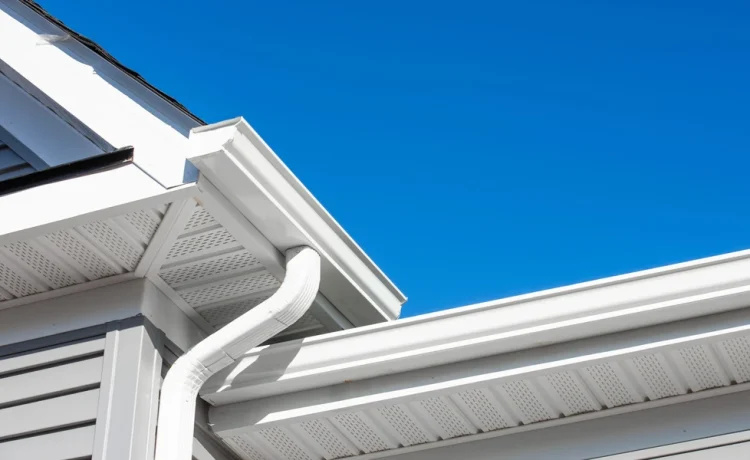
The outlet is the hole cut into the bottom of the gutter where the downspout attaches. It needs a clean cut, a properly sealed drop outlet and the right downspout size for the roof area it serves. A small 2×3 downspout draining a large roof section can back up quickly, while a 3×4 offers roughly double the opening.
Where the water goes next matters just as much. The EPA’s Soak Up the Rain guidance on redirecting downspouts explains how sending roof water into planted areas, rain barrels or gardens lets it soak in rather than run off. On rural lots with decomposed granite and sloped driveways, that approach also keeps runoff from carving channels near the foundation.
What to look for: erosion at the downspout base, overflow directly above an outlet, or a downspout pulling away from the wall.
End Caps at Both Ends of the Run
End caps close off each run and are sealed into the gutter profile. They rarely fail on their own, but they take the full force of water that has nowhere else to go when an outlet clogs with pine needles or wind blown debris.
What to look for: drips at the far ends of the gutter, especially on runs with only one downspout.
Hangers and the Fascia Behind Them
Hangers carry the weight of the gutter plus whatever water, debris or ice it holds. Hidden hangers screwed through the front lip into the fascia are common today, and spacing them closer together helps in areas that see snow and ice.
At elevations around 4,500 feet, freezing nights follow sunny winter days, so meltwater can refreeze inside shaded gutters. That ice adds weight and stress at every fastener. If the fascia board behind the hangers has dried out, cracked or started to rot, screws lose their grip and the gutter begins to sag.
Metal fascia wrap covers worn wood with formed aluminum, giving hangers a sound surface and ending the repainting cycle that intense sun makes so frequent.
What to look for: waves along the gutter line, gaps between gutter and fascia, or peeling paint around fasteners.
Material Thickness and Expansion
Aluminum is the most common seamless material in the region, usually formed from coil in a few standard thicknesses. Thicker coil resists dents from hail, ladders and falling branches better than thinner stock. Steel offers more strength but needs a good coating to resist rust, while copper is durable and expensive.
Aluminum also expands and contracts with temperature. Long continuous runs need hangers that allow slight movement, and very long eaves sometimes benefit from placing downspouts so that water and stress are split between sections.
What to look for: dents, buckling on very long runs, or chalky, faded paint on the gutter face.
Checking the Work and the Contractor
A seamless system is only as good as the person forming and hanging it. Arizona requires most contractors to hold a license through the Registrar of Contractors, and the agency’s reminder to check a license before hiring is a useful step before any exterior project. It also warns about door to door solicitors who show up offering discounted repairs with leftover materials.
A thorough estimate should cover gutter size, downspout size and placement, hanger type and spacing, coil thickness, corner construction and the condition of the fascia. When those details are written down clearly, comparing bids becomes far easier.
Reading Your Own Gutters After the Next Storm
Every gutter tells its own story once the rain stops. Drips at corners point to miter problems, stains at mid span point to failing joints, and sagging points to hangers or the wood behind them. Paying attention to those clues after a heavy storm shows exactly which link in the chain needs attention, and it helps homeowners decide whether a simple repair will do or whether a continuous replacement makes more sense for the years ahead.

Robert Jerry writes about home living, décor ideas, and lifestyle improvements. His focus is on creating comfortable, functional spaces that enhance everyday living experiences.