Underground infrastructure is one of the most vital yet overlooked components of residential and commercial property management. Beneath manicured lawns, concrete driveways, and high-value hardscaping lies a continuous network of sewer laterals tasked with transporting wastewater away from buildings. Over decades of service, subterranean pipelines face persistent stress from expansive soils, seismic settling, material degradation, and aggressive root systems seeking moisture. Historically, resolving a compromised sewer main required heavy excavation equipment, open trenches across properties, high labor costs, and long disruption periods.
Today, trenchless engineering has fundamentally transformed how subterranean pipe failures are diagnosed and resolved. Rather than tearing up surface structures, modern trenchless specialists utilize minimal-entry access points to inspect, rehabilitate, or entirely replace damaged underground pipes. Regional engineering teams, including Trenchless Sewer Plumbing Inc., deploy high-definition video diagnostics alongside cured-in-place pipe lining and pipe bursting techniques to execute full-system restorations without requiring disruptive landscape trenching.
Understanding the mechanisms of modern no-dig repair allows property managers, building owners, and municipalities to make informed structural decisions. By evaluating the physical condition of buried host pipes early, stakeholders can avoid catastrophic line collapses, safeguard surrounding hardscapes, and adhere to environmental compliance standards.
The Invisible Causes of Subterranean Sewer Failure
Underground lateral lines are constructed from various materials depending on the era of installation. Mid-century properties frequently rely on vitrified clay, cast iron, or bituminous fiber pipes. While durable under normal conditions, each material possesses specific vulnerability profiles over time.
- Vitrified Clay Pipes: Extremely rigid and resistant to chemical corrosion, clay pipes are installed in short jointed segments. Ground movement creates micro-gaps at these joints, providing an entry point for tree roots.
- Cast Iron Lines: Subject to internal tuberculation and bottom-channel scale accumulation. Over decades, water exposure causes bottom-wall thinning and eventual structural failure.
- Fiber Conduit Pipes: Highly prone to flattening under soil overburden pressure and absorbing water, leading to localized collapses.
In addition to material aging, subterranean environments present constant physical stresses. Soil thermal expansion, heavy vehicle loads on driveways, and minor seismic shifts cause shear stresses that crack unreinforced pipes. Once a hairline fissure develops, escaping moisture attracts surrounding tree roots, which expand within the pipe interior and act as continuous collection points for organic waste.
Diagnostic Precision: High-Definition Sewer Camera Inspections
Before any physical repair begins, accurate subterranean mapping is essential. Modern trenchless protocols strictly prohibit guessing pipe conditions based on surface symptoms alone.
A flexible rod equipped with a self-leveling, waterproof camera head is inserted through an existing cleanout access point. As the camera travels down the lateral, real-time video feeds display internal structural conditions on portable digital monitors.
- Defect Identification: Technicians pinpoint structural cracks, offset joints, root intrusion severity, foreign blockages, and low spots (sags or bellies) holding standing water.
- Sonde Location Mapping: Built-in radio transmitters (sondes) emit signals from the subterranean camera position. Surface receivers locate the precise depth and position of the pipe beneath dirt or concrete.
- Dimensional Measurements: Precise diameter measurements ensure custom-fit flexible liners or replacement piping materials are fabricated to exact internal tolerances.
Primary Trenchless Methodologies Compared
When structural repairs are necessary, two primary trenchless techniques are employed: Cured-In-Place Pipe (CIPP) Lining and Pipe Bursting. Selecting the appropriate strategy depends on the structural integrity of the existing host pipe.
| Evaluation Metric | Cured-In-Place Pipe (CIPP) Lining | Hydraulic Pipe Bursting |
|---|---|---|
| Primary Mechanism | Inversion of epoxy-resin saturated liner | Expansion head shatters host pipe while pulling new HDPE line |
| Host Pipe Condition | Must maintain structural shape without full collapse | Ideal for collapsed, severely offset, or undersized pipes |
| Property Entry Requirements | Single cleanout or minor entry pit | Small launch and receiving pits at pipe ends |
| Internal Pipe Diameter | Minor reduction (approx. 2-5%) | Maintains original size or allows pipe expansion (upsizing) |
| Material Composition | Seamless structural epoxy felt tube | High-Density Polyethylene (HDPE) mono-pipe |
| Estimated Lifespan | 50+ Years | 50-100 Years |
Cured-In-Place Pipe (CIPP) Lining
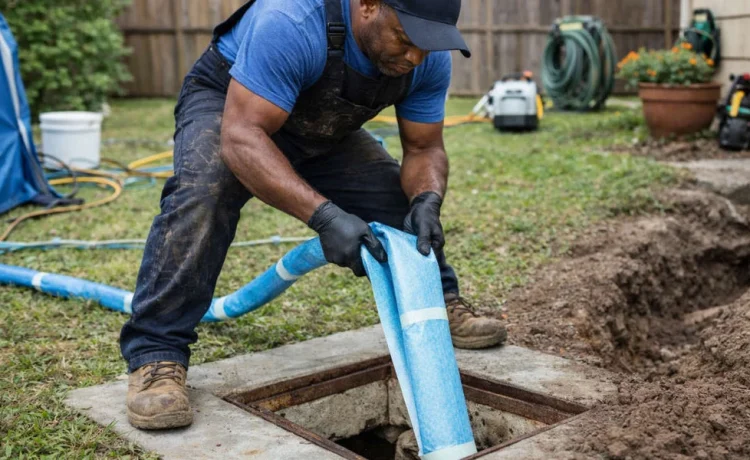
CIPP lining acts as a seamless “pipe within a pipe.” A flexible felt tube saturated with a thermosetting epoxy resin is inverted or pulled into the damaged host line using compressed air or water pressure. Once positioned, the liner is inflated against the interior walls of the old pipe. Heat (steam/hot water) or light-curing technology triggers a chemical reaction, hardening the resin into a smooth, structural wall. Organizations such as the North American Society for Trenchless Technology establish rigorous testing criteria for these resin systems to ensure long-term structural integrity against earth loads and chemical exposure.
Pipe Bursting
When a sewer pipe has completely collapsed or lost its structural roundness, CIPP lining cannot be used. Pipe bursting offers a trenchless replacement solution. A high-strength steel cable guides a conical bursting head through the damaged host pipe. Powered by hydraulic pullers, the bursting head fractures the existing host pipe outward into the surrounding soil matrix while simultaneously pulling a continuous strand of High-Density Polyethylene (HDPE) pipe directly behind it. The result is a brand-new pipe completely independent of the old host pipe’s condition.
Municipal Regulations and Owner Obligations
Property owners are frequently surprised to learn where their legal responsibility for sewer maintenance begins and ends. In most municipalities, the building owner holds full maintenance responsibility for the private lateral line from the structure all the way to the connection at the municipal sewer main under the public street.
According to municipal guidelines published by agencies like Los Angeles County Public Works, failures occurring underneath public sidewalks or street pavement still fall within the financial responsibility of the private property owner. Because conventional open-trench repairs beneath public roadways require costly asphalt cutting, traffic control permits, and street restoration, trenchless pipe bursting and directional lining offer significant cost and time savings when resolving street-section lateral failures.
Key Indicators That Your Lateral Line Requires Evaluation
Identifying sewer line distress early prevents complete structural failure and interior sewage backups. Property owners should monitor for the following technical warning signs:
- Simultaneous Multi-Fixture Slow Draining: When lower-floor toilets, bathtubs, and floor drains back up together, the issue resides in the main lateral line rather than individual branch lines.
- Hydrostatic Pressure Gurgling: Air trapped by main line blockages pushes back through fixture traps, causing visible bubbling and audible gurgling during water discharge.
- Isolated Soil Moisture and Lush Foliage: Escaping nutrient-rich wastewater acts as subsurface fertilizer, creating unusually green grass or sinking soil patches above the pipe path.
- Persistent Sewer Gas Odors: Cracks in underground lateral walls allow sewer gases (such as hydrogen sulfide) to escape through soil fissures into yards or lower-level foundations.
Preventive Habits and System Preservation
Once a sewer lateral has been rehabilitated using modern trenchless techniques, basic preventative care ensures the new pipeline achieves its maximum design life:
- Eliminate Non-Biodegradable Discharges: Wipes, paper towels, grease, and heavy fats should never enter the drain system. Even smooth epoxy-lined pipes can experience fatberg accumulations from heavy grease disposal.
- Conduct Periodic Camera Audits: Scheduling a visual video inspection every few years allows early detection of debris buildup before blockages form.
- Avoid Harsh Chemical Solvents: Caustic drain cleaning chemicals can damage localized seals, harm municipal water treatment systems, and fail to remove solid obstructions like tree roots. Mechanical hydro-jetting remains the safest cleaning alternative.
Trenchless engineering represents a major step forward in urban utility maintenance. By replacing destructive excavation with high-precision diagnostics and trenchless rehabilitation methods, modern infrastructure systems can be continuously renewed while protecting the landscapes, hardscapes, and architectural features above ground.

Robert Jerry writes about home living, décor ideas, and lifestyle improvements. His focus is on creating comfortable, functional spaces that enhance everyday living experiences.